
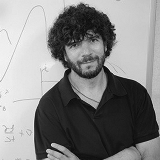
Julio F. Navarro

Julio F. Navarro

Program
Cosmology and Gravity

Appointment
Fellow

Institution
University of Victoria

Country
Canada Canada

Julio F. Navarro grew up in Argentina, where he attended one of the main universities in that country's national university system: the Universidad Nacional de Cordoba.  There he joined, as a graduate student, the Astronomy program at the Observatorio Nacional de Cordoba, one of the oldest astronomical institutions in the southern hemisphere, and he later became a Predoctoral Fellow of the Smithsonian Astrophysical Observatory, located in Cambridge, MA, USA.  After completing his PhD in 1990, he held postdoctoral appointments at the Institute of Astronomy, Cambridge University, and at the University of Durham, England.  In 1994, he was awarded the Bart J. Bok Fellowship at the University of Arizona, a position which he held until April 1, 1998, when he joined the University of Victoria as an Assistant Professor at the Department of Physics and Astronomy.  He is now full Professor at the University of Victoria and a Fellow in CIFAR's Cosmology and Gravity Program.  Dr. Navarro received a Fellowship from the Sloan Foundation in 1999 and from the Guggenheim Foundation in 2003.  In 2004, he was awarded a UK Leverhulme Trust Visiting Professorship and the Friedrich Wilhelm Bessel Prize from the Humboldt Foundation.

Dr. Navarro describes his research interests as follows:

My research interests concern the study of the formation and evolution of galaxies and galaxy clusters, with particular emphasis on their cosmological origin as well as on the structure and dynamics of their stellar, gaseous, and dark matter components.

Many of these complex issues are best addressed using direct numerical simulations, for which I have developed a general purpose, gridless, fully Lagrangian code well suited for evolving a mixture of collisionless and collisional fluids in three dimensions. The code combines a fast tree-based algorithm for the computation of gravitational N-body interactions with the Smooth Particle Hydrodynamics (SPH) approach to numerical hydrodynamics.

Applications of this code to the formation of dark matter halos, galactic disks, and X-ray clusters have highlighted a number of successes and shortcomings of hierarchical theories of structure formation.

-- The baryon content of galaxy clusters can be combined with primordial nucleosynthesis calculations to provide strong constraints on the value of the density parameter Omega.

-- Simple models of the intracluster medium based on the gravitational collapse of non-radiative gas within evolving dark matter halos cannot explain the observed structure and evolution of X-ray clusters, and stress the importance of non-gravitational processes such as radiative cooling and energy feedback from galaxy formation in the evolution of the intracluster medium.

-- The density profiles of dark matter halos have a "universal shape', independent of the mass of the halo, of the spectrum of initial density fluctuations, and of the cosmological parameters. This remarkable structural similarity can be used in observational studies of the mass profiles of galaxies and galaxy clusters to constrain cosmological models.

-- Our N-body/gasdynamical simulations have highlighted the importance of feedback from evolving stars and supernovae during galaxy formation. Without feedback, most of the baryons in the universe would be locked up in galaxies, in disagreement with observations. Furthermore, the spin of these galaxies would be much lower than inferred from observations of spiral galaxies because of large angular momentum losses incurred during the merger events that characterize the hierarchical buildup of galactic systems.

Support CIFAR

Donate

CIFAR E-News

Sign Up

Follow Us Online

Fast Facts

Founded: 1986
Renewal Dates: 1991, 1996, 2001, 2006
Number of Members: 50
Disciplines Represented:
  • Numerical relativity
  • Particle astrophysics
  • Physical cosmology (theoretical, experimental and observational)
  • High energy astrophysics (theoretical and observational)
  • String theory
Supporters:
  • R. Howard Webster Foundation